
Sleep, Testosterone and Men’s Health: Why Your Nightly Routine Matters
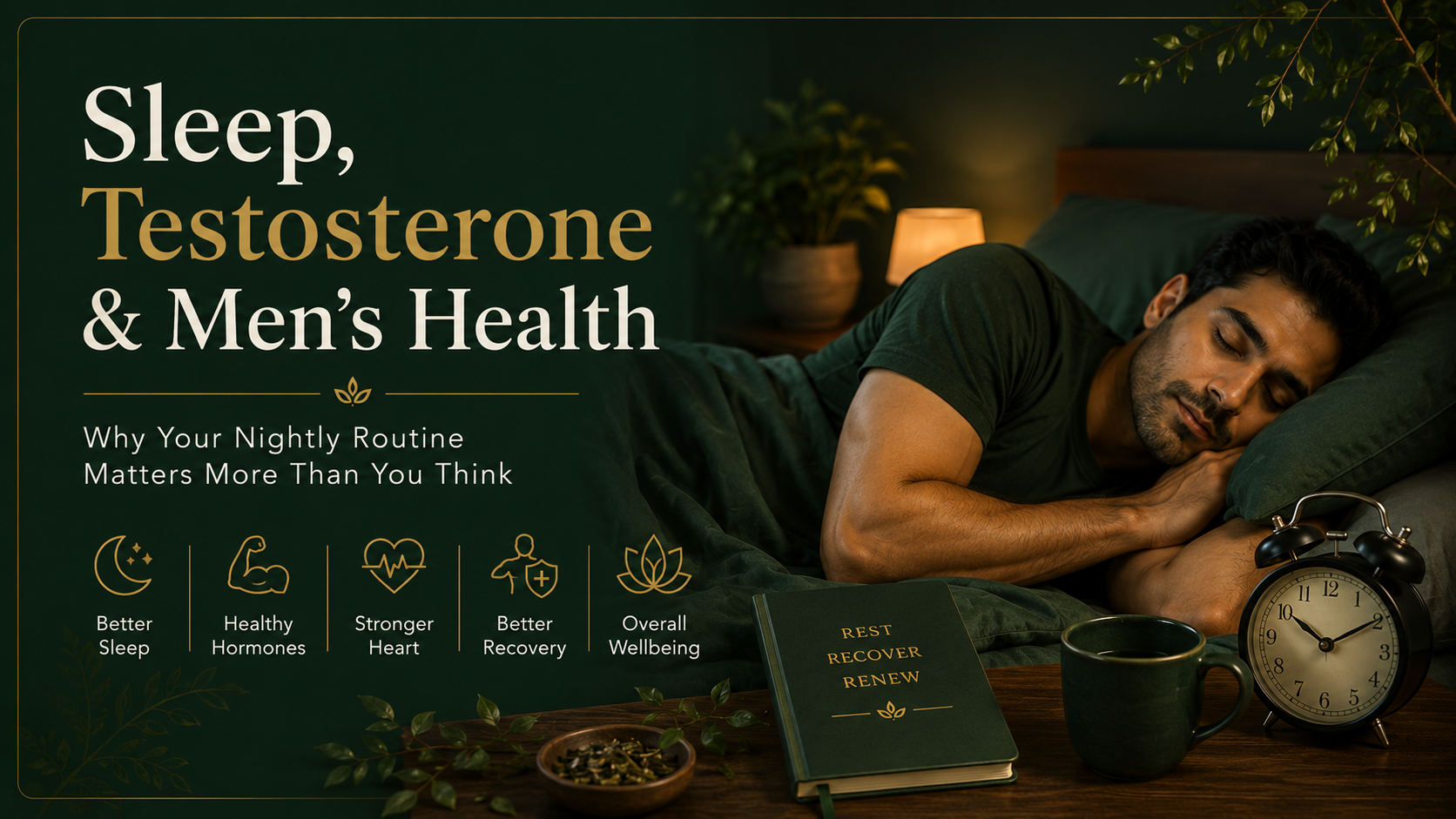
Sleep is one of the most overlooked foundations of men's health.
It affects far more than how energetic you feel the next morning. Sleep is closely connected with hormonal regulation, cardiovascular health, metabolism, mood and physical recovery.
Recent research continues to highlight the relationship between sleep, cardiovascular health and testosterone. Poor sleep and sleep disorders may be associated with hormonal and metabolic changes, while improving sleep quality can form an important part of a broader approach to men's wellbeing.
The important takeaway is simple: before looking for a pill, powder or supplement to support men's health, look at the quality of your sleep.
Key Takeaways
- Sleep plays an important role in hormonal and metabolic health.
- Poor sleep may affect testosterone and other physiological systems.
- Sleep health is closely connected with cardiovascular health.
- Regular exercise can support both physical and sleep health.
- Alcohol, irregular sleep schedules and excessive late-night screen use can interfere with good sleep habits.
- Persistent snoring, daytime sleepiness or disrupted sleep may warrant professional evaluation.
- Supplements should complement—not replace—sleep, nutrition, exercise and medical care.
Testosterone Is Only One Part of the Picture
Testosterone often dominates conversations about men's health.
From gym performance to muscle mass, energy and sexual health, testosterone is frequently presented as the master hormone of male wellbeing.
But the body does not work in isolation.
Testosterone interacts with sleep, body composition, physical activity, metabolic health and overall lifestyle. A recent 2026 review examining sleep disorders, cardiovascular disease and testosterone described these systems as closely interconnected. :contentReference[oaicite:1]{index=1}
That means focusing exclusively on testosterone numbers can miss a much bigger part of the picture.
Healthy hormonal function begins with healthy foundations.
And sleep is one of them.
What Happens When You Sleep?
Sleep is an active biological process rather than simply a period of inactivity.
During sleep, the body carries out numerous processes involved in:
- Physical recovery
- Metabolic regulation
- Brain function
- Immune function
- Hormonal regulation
- Cardiovascular health
The quality of sleep matters as well as the number of hours spent in bed.
A recent review published in 2026 highlighted several dimensions of sleep that may influence cardiovascular health, including duration, regularity, timing, quality and efficiency. :contentReference[oaicite:2]{index=2}
In other words, sleeping for a sufficient number of hours does not necessarily mean that your sleep is healthy.
Sleep and Testosterone
Testosterone follows a biological rhythm, and sleep is an important part of that system.
Disrupted sleep, insufficient sleep and sleep disorders can interfere with normal hormonal regulation.
This does not mean that one poor night's sleep will suddenly cause testosterone levels to collapse.
The bigger concern is persistent poor sleep.
Repeatedly sleeping badly may become part of a wider pattern involving fatigue, reduced physical activity, changes in body composition, poor metabolic health and impaired recovery.
This is why chasing testosterone directly without addressing sleep can be an incomplete strategy.
The Sleep–Heart Health Connection
Men's health is often divided into separate categories:
Hormones.
Heart health.
Fitness.
Metabolism.
Mental wellbeing.
In reality, these systems overlap.
A 2026 review examining sleep and cardiovascular health noted that sleep characteristics interact with movement and dietary behaviours when considering cardiovascular risk. :contentReference[oaicite:3]{index=3}
This makes sleep particularly important for men who are already dealing with other lifestyle risk factors.
A good night's sleep is not a substitute for exercise or a balanced diet.
But it is part of the same health equation.
Exercise Helps—But Recovery Matters Too
Exercise is one of the most reliable lifestyle tools for maintaining overall health.
Recent research continues to support the role of aerobic exercise in men's metabolic, cardiovascular and inflammatory health. :contentReference[oaicite:4]{index=4}
Exercise can also influence mood and sleep.
A 2026 systematic review and meta-analysis of randomized trials found that aerobic exercise can improve positive mood and reduce negative mood, although its effects on cognition were less consistent. :contentReference[oaicite:5]{index=5}
But there is an important distinction:
Training is the stimulus.
Recovery is where the body adapts.
If intense workouts are consistently combined with poor sleep, high stress and inadequate nutrition, the overall benefit of the lifestyle may be reduced.
Men who exercise regularly should therefore treat sleep as part of their training routine—not as something separate from it.
What About Strength Training?
Strength training is valuable for maintaining muscle mass, strength and physical function as men age.
Interestingly, recent research has also examined how different forms of resistance training influence sleep quality and nighttime physiological responses in young men. :contentReference[oaicite:6]{index=6}
This does not mean that every man needs a complicated gym programme.
A sustainable combination of resistance exercise, aerobic activity, adequate nutrition and consistent sleep is a much more useful long-term strategy.
Hydration Matters Too
Hydration is another seemingly simple part of men's wellness that can be overlooked.
A recent 2026 randomized study in recreationally resistance-trained men found that dehydration reduced heart-rate variability during the study conditions. :contentReference[oaicite:7]{index=7}
The practical lesson is not that every man needs to drink excessive quantities of water.
Rather, hydration should be considered alongside exercise, climate, diet and individual needs.
The goal is adequate hydration—not simply drinking as much water as possible.
Five Habits That Can Support Better Sleep
You don't need a complicated sleep protocol.
Start with the basics.
1. Keep a Consistent Sleep Schedule
Going to bed and waking up at roughly the same time each day can help establish a more stable sleep rhythm.
Consistency is particularly important when weekends routinely involve dramatically different sleeping hours.
2. Create a Wind-Down Period
Give your mind time to transition from work and stimulation into rest.
Dim the lights.
Reduce unnecessary screen use.
Read.
Take a warm shower.
Practise quiet breathing.
The objective is to create a predictable signal that the day is ending.
3. Exercise Regularly
Physical activity supports cardiovascular health, metabolic health and overall wellbeing.
However, exercise should be balanced with sufficient recovery.
If you are constantly exhausted, more training is not necessarily the answer.
4. Pay Attention to Your Bedroom
A dark, quiet and comfortable sleeping environment can make it easier to maintain good sleep.
Temperature, noise and light are easy factors to overlook.
Small environmental improvements can sometimes have a surprisingly large impact on consistency.
5. Don't Ignore Persistent Sleep Problems
Occasional poor sleep is normal.
Persistent problems are different.
Loud habitual snoring, waking repeatedly during the night, morning headaches, excessive daytime sleepiness or regularly waking feeling unrefreshed can warrant discussion with a healthcare professional.
Sleep disorders can affect much more than energy levels.
Can Ayurveda Support Better Sleep?
Ayurveda has traditionally placed considerable emphasis on daily routine, appropriate diet, rest and maintaining balance.
The broader Ayurvedic approach is therefore compatible with an important modern principle:
Wellness is not built around one isolated intervention.
A consistent daily routine, appropriate food, physical activity, adequate rest and mindful habits form the foundation.
Herbs and traditional preparations may have a place within an individual's wellness routine, but they should not be presented as substitutes for diagnosing or treating sleep disorders.
For persistent insomnia or suspected sleep apnea, professional medical evaluation is more important than self-treatment.
The Ministry of Ayush maintains a dedicated research portal containing research relating to Ayurveda and other AYUSH systems, reflecting the growing effort to document traditional practices through research. :contentReference[oaicite:8]{index=8}
What About Shilajit?
Shilajit is traditionally used in Ayurveda as a Rasayana and is commonly associated with vitality and general wellbeing.
However, it should not be marketed as a replacement for sleep or as a guaranteed way to increase testosterone.
A more sensible approach is to think about Shilajit, when appropriate, as one component of a broader wellness routine.
The fundamentals remain:
Sleep well.
Eat well.
Move regularly.
Manage stress.
Stay hydrated.
And use supplements responsibly.
When Should Men Consider a Health Check?
Persistent fatigue should not automatically be blamed on low testosterone.
Similar symptoms can have many possible causes.
If you experience ongoing:
- Fatigue
- Reduced exercise tolerance
- Changes in sexual health
- Persistent mood changes
- Unexplained weight changes
- Poor sleep
- Excessive daytime sleepiness
it may be worth discussing them with a healthcare professional.
Testing should be based on symptoms and clinical judgement rather than simply ordering every available hormone test.
Frequently Asked Questions
Does poor sleep lower testosterone?
Persistent sleep disruption may affect hormonal regulation, including testosterone. However, testosterone levels are influenced by many factors, and one poor night's sleep should not be interpreted as evidence of testosterone deficiency.
How many hours should men sleep?
There is no single number that guarantees good health for every individual. Most adults require roughly 7–9 hours of sleep, but sleep quality, regularity and individual needs also matter.
Can exercise increase testosterone?
Exercise can influence testosterone levels, but the response depends on factors such as exercise type, intensity, training status and individual characteristics. Research on acute exercise and testosterone has produced varied findings. :contentReference[oaicite:9]{index=9}
Exercise should therefore be viewed primarily as a cornerstone of overall health rather than simply a testosterone-boosting technique.
Is snoring normal?
Occasional snoring can occur, but loud habitual snoring accompanied by daytime sleepiness or disrupted sleep may indicate an underlying sleep disorder. Persistent symptoms should be evaluated professionally.
Does sleeping more always mean better health?
Not necessarily.
Sleep duration is only one dimension of sleep health. Regularity, quality, timing and efficiency also matter. :contentReference[oaicite:10]{index=10}
Can supplements replace good sleep?
No.
Supplements cannot compensate for chronically inadequate sleep, poor nutrition, inactivity or an untreated sleep disorder.
Final Thoughts
Men's health is often marketed through a single number: testosterone.
But healthy ageing is considerably more complicated.
Hormones, cardiovascular health, metabolism, physical activity, nutrition, stress and sleep all influence one another.
And sleep may be one of the simplest places to begin.
Before searching for the next testosterone booster or performance supplement, ask a more basic question:
Am I giving my body enough time and the right conditions to recover?
A consistent sleep routine, regular exercise, balanced nutrition and appropriate medical care provide a far stronger foundation for long-term men's wellness than any single supplement.
Quality & Transparency
This article is intended for educational purposes only and should not be considered medical advice. The information presented reflects current research and traditional wellness perspectives but does not establish that any supplement can prevent, treat or cure a medical condition.
If you have persistent sleep problems, symptoms of hormonal deficiency, cardiovascular concerns, or any other health condition, consult a qualified healthcare professional.
About Vaaya
At Vaaya, we believe that authentic wellness begins with trust.
Our approach combines the wisdom of Ayurveda with a commitment to informed, responsible wellness. We believe natural products have their place in a modern lifestyle—but they should be understood within the larger picture of nutrition, movement, sleep and healthy daily habits.
The goal is not more supplements.
The goal is better wellbeing.
Sources
- PubMed — “The role of sleep in cardiovascular health and disease risk” (2026)
- PubMed — “Sleep apnea, heart health and testosterone: unravelling the triad of well-being” (2026)
- PubMed Central — “Comparative effects of combined aerobic exercise-based interventions on metabolic, cardiovascular, and inflammatory markers in adult men” (2026)
- PubMed — “Effects of aerobic exercise on cognition, sleep, and mood in healthy adults” (2026)
- PubMed — “Dehydration reduces heart rate variability in recreationally resistance-trained men” (2026)
- PubMed Central — “Effect of acute exercise on the dynamics of testosterone levels: a systematic review of randomized controlled trials” (2026)
- Ministry of Ayush — AYUSH Research Portal
Begin your Shilajit ritual
Vaaya Shilajit is sourced from high-altitude Himalayan rock, purified the traditional Ayurvedic way, and lab-tested for heavy metals. Whether you start with the pure resin, the gold resin, or the travel-friendly capsules, consistency is what changes how you feel.
Questions? Write to us at care@vaayaayurveda.com
Related reading
 Everyday Wellness28 Sept 202610 min read
Your Body Has a Clock: How Daily Routines Affect Your Health
Your body follows a natural 24-hour rhythm that influences when you feel awake, sleepy, hungry and ready to rest. Discover how everyday habits such as morning light, meal timing, movement and consistent sleep can help support your body's internal clock.
Read article Digestive Wellness7 Sept 202611 min read
Dietary Fibre: Why Your Gut Needs More Than Just Roughage
Dietary fibre is more than something that keeps digestion moving. From whole grains and pulses to fruits, vegetables, nuts and seeds, fibre-rich foods can support digestive health and form an important part of a balanced diet.
Read article Healthy Ageing5 Sept 202610 min read
Healthy Ageing: 8 Everyday Habits That Help You Age Well
Ageing is inevitable, but how we age is influenced by many factors. Discover eight practical habits that can support physical health, mental wellbeing, mobility and independence as you grow older.
Read article