
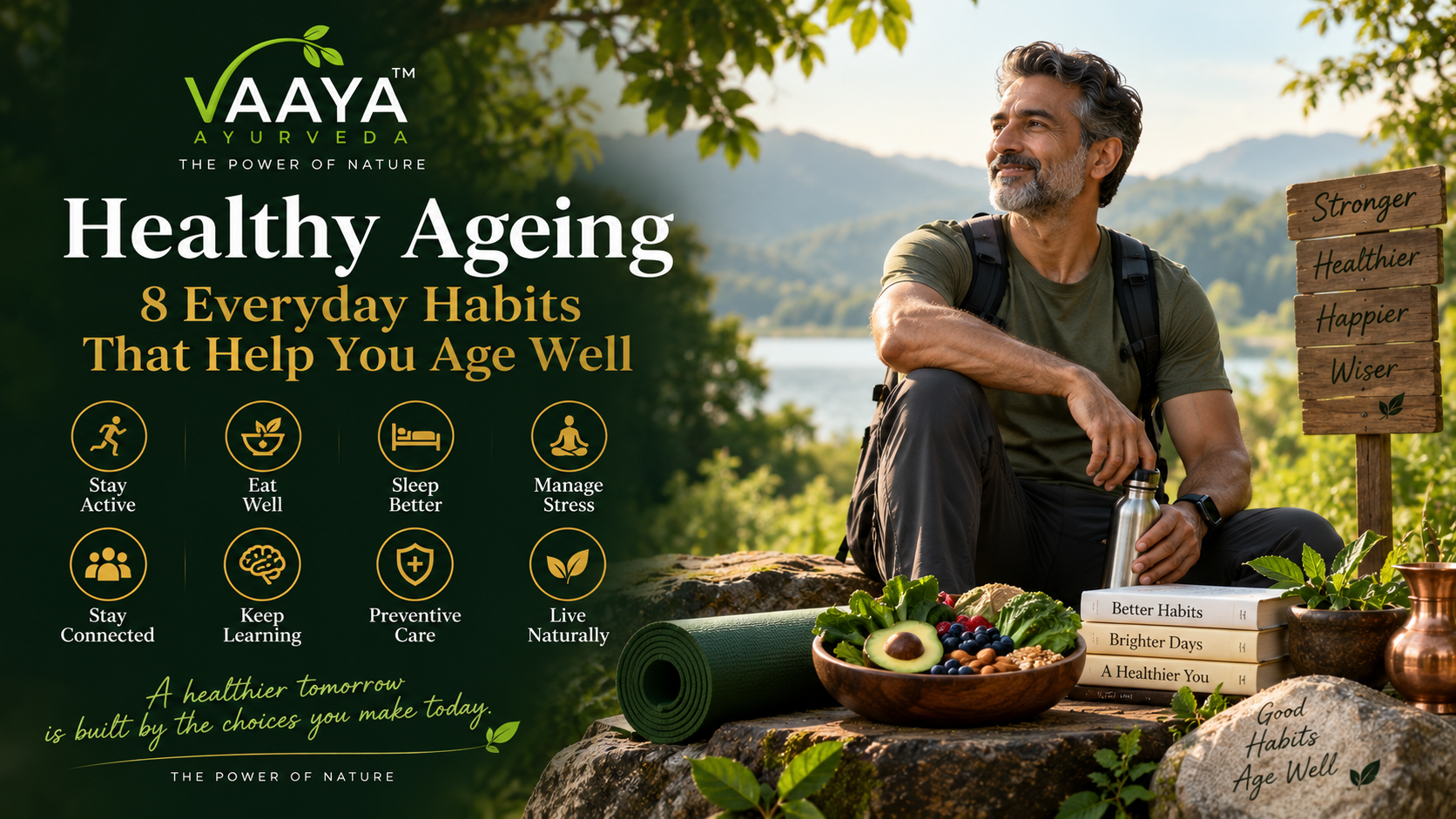
Healthy Ageing: 8 Everyday Habits That Help You Age Well
Healthy Ageing: 8 Everyday Habits That Help You Age Well
Ageing is a natural part of life. The goal of healthy ageing is not to stop getting older—it is to maintain as much physical function, mental wellbeing, independence and quality of life as possible as the years pass.
Genetics influence how we age, but lifestyle and environmental factors matter too.
The most useful approach is surprisingly simple:
Move regularly.
Eat a varied, nutritious diet.
Sleep well.
Stay socially connected.
Keep your mind active.
Manage stress.
Avoid tobacco and excessive alcohol.
Keep up with appropriate healthcare and preventive check-ups.
Healthy ageing is not a single treatment or supplement. It is the cumulative result of habits repeated over many years.
Key Takeaways
• You cannot stop ageing, but you can influence many aspects of how you age.
• Regular physical activity helps preserve strength, mobility and functional ability.
• A nutritious, varied diet supports muscles, bones and overall health.
• Sleep is important for physical, emotional and cognitive wellbeing.
• Social connection and meaningful activity are part of healthy ageing.
• Learning new things and maintaining mental engagement can help keep life stimulating.
• Yoga, breathing practices and mindfulness can complement a healthy lifestyle.
• There is no single "anti-ageing" food, herb or supplement that can replace healthy daily habits.
What Does Healthy Ageing Actually Mean?
When people hear the phrase "healthy ageing," they often think about wrinkles, grey hair or looking younger.
But healthy ageing is much bigger than appearance.
A better question is:
"Can I continue doing the things that matter to me as I grow older?"
That might mean:
• Walking comfortably
• Climbing stairs
• Playing with your children or grandchildren
• Travelling
• Working
• Exercising
• Cooking for yourself
• Learning new skills
• Maintaining friendships
• Making your own decisions
• Enjoying everyday life
Ageing well is therefore less about looking young and more about maintaining function, independence and quality of life.
1. Keep Moving
If there is one habit that deserves a permanent place in a healthy-ageing routine, it is regular physical activity.
Movement helps maintain muscle strength, cardiovascular fitness, balance and mobility.
And you don't necessarily need an elaborate workout programme.
Walking, cycling, swimming, dancing, gardening, yoga and strength training can all contribute to an active lifestyle.
For adults, WHO recommends at least 150 minutes of moderate-intensity physical activity per week, with muscle-strengthening activities on two or more days each week.
For older adults, activities that improve balance and help prevent falls become particularly important.
The key is consistency.
A little movement repeated regularly is generally more useful than an intense workout performed occasionally.
2. Protect Your Muscle as You Age
Muscle deserves special attention as we get older.
Strength supports everyday independence.
Standing up from a chair, carrying groceries, climbing stairs and maintaining balance all depend on physical capacity.
This is why resistance training can be valuable as part of a healthy-ageing routine.
You don't necessarily need a gym.
Depending on your fitness level, exercises can include:
• Squats
• Wall push-ups
• Resistance-band exercises
• Light weights
• Step-ups
• Bodyweight movements
• Yoga
If you are new to exercise, start gradually and choose activities appropriate for your current ability.
3. Eat for Nourishment, Not Just Calories
Healthy ageing is not about eating as little as possible.
Your body needs adequate nutrition to maintain muscle, bone, immune function and energy.
A varied diet can include:
• Vegetables
• Fruits
• Whole grains
• Pulses and legumes
• Nuts and seeds
• Dairy or suitable alternatives
• Eggs, fish or other protein sources
• Healthy fats
Rather than searching for one "superfood," focus on dietary variety.
The best diet is usually the one that provides a broad range of nutrients and is sustainable enough to follow for years.
4. Take Sleep Seriously
Sleep is often treated as something we can sacrifice when life becomes busy.
But sleep is not wasted time.
It plays an important role in energy, mood, attention, memory and overall health.
Poor sleep can affect how you function during the day and may contribute to a range of health problems over time.
A few simple habits can help:
• Keep a relatively consistent sleep schedule.
• Create a relaxing bedtime routine.
• Keep your bedroom comfortable and conducive to sleep.
• Exercise regularly.
• Avoid excessive caffeine late in the day.
• Limit stimulating activities close to bedtime.
If persistent sleep problems are affecting your daily life, speak with a healthcare professional rather than simply accepting poor sleep as a normal part of ageing.
5. Keep Your Mind Active
The brain also benefits from continued engagement.
Learning doesn't have to stop when formal education ends.
Read a book.
Learn a language.
Play an instrument.
Solve puzzles.
Learn to cook something new.
Take a course.
Travel somewhere unfamiliar.
Develop a hobby.
Have thoughtful conversations.
The goal isn't to turn every activity into "brain training."
It is to remain curious and mentally engaged with life.
Learning something new can also provide a sense of achievement and purpose.
6. Don't Underestimate Relationships
Healthy ageing is not only physical.
Human beings need meaningful social connections.
Family, friendships, community activities, volunteering, hobbies and shared interests can all provide opportunities for connection.
Loneliness and social isolation are associated with poorer health outcomes, including increased risks related to mental health and cognitive wellbeing.
This doesn't mean you need a huge social circle.
A few meaningful relationships can be more valuable than hundreds of superficial interactions.
Make time for people you care about.
Call someone.
Share a meal.
Go for a walk together.
Join a group based around an interest you genuinely enjoy.
Connection is part of health too.
7. Learn to Manage Stress
Stress is unavoidable.
The goal is not to eliminate every stressful experience.
It is to develop healthier ways of responding to it.
Different approaches work for different people:
• Walking
• Exercise
• Meditation
• Yoga
• Deep breathing
• Journaling
• Spending time in nature
• Prayer or contemplative practices
• Music
• Meaningful conversations
• Hobbies
Ayurveda and yoga have long placed emphasis on the relationship between daily routine, mental balance and overall wellbeing.
Modern research also increasingly examines practices such as yoga and mindfulness for stress management and healthy ageing.
The important point is to find practices that are realistic enough to become part of everyday life.
8. Keep Preventive Healthcare on Your Calendar
Healthy habits do not eliminate the need for healthcare.
As we age, appropriate health checks become increasingly important.
Depending on your age, sex, family history and individual circumstances, preventive care may include monitoring:
• Blood pressure
• Blood glucose
• Cholesterol
• Vision
• Hearing
• Dental health
• Bone health
• Other age-appropriate screenings
The exact recommendations vary between individuals.
Your doctor can help determine which preventive checks are appropriate for you.
Prevention is not about assuming something is wrong.
It is about identifying potential problems early and managing health proactively.
What About Anti-Ageing Supplements?
This is where the wellness industry can become confusing.
You will find products claiming to:
"Reverse ageing."
"Turn back the biological clock."
"Restore youth."
"Extend your lifespan."
Be cautious.
No supplement can replace the fundamentals of healthy ageing.
Some nutrients and traditional herbs may have legitimate nutritional or traditional uses, but that is very different from proving that a product can reverse human ageing.
A responsible wellness approach should distinguish between:
• Traditional use
• Nutritional value
• Early scientific research
• Established clinical evidence
These are not interchangeable.
Can Ayurveda Help With Healthy Ageing?
Ayurveda has a long tradition of thinking about health as something that should be maintained throughout life rather than addressed only after illness appears.
The classical Ayurvedic concept of Rasayana is traditionally associated with nourishment, vitality and supporting healthy longevity.
However, traditional concepts should not automatically be presented as scientifically proven anti-ageing treatments.
A modern approach can instead appreciate the broader principles:
• Consistent daily routines
• Appropriate nutrition
• Physical activity
• Rest and sleep
• Mental balance
• Moderation
• Attention to individual constitution and circumstances
These principles can complement modern healthy-lifestyle guidance without requiring exaggerated claims.
The 80/20 Principle of Healthy Ageing
You don't need to transform your life overnight.
Start with the basics.
Walk more.
Build some strength.
Eat more whole foods.
Sleep consistently.
Stay connected.
Learn something.
Spend time outdoors.
Manage stress.
Keep up with appropriate healthcare.
Then repeat.
Healthy ageing is not created by one extraordinary intervention.
It is created by ordinary habits performed consistently over extraordinary amounts of time.
Frequently Asked Questions
Can you slow down ageing?
You cannot stop chronological ageing. However, many lifestyle factors influence health, physical function and quality of life as people grow older.
What is the best exercise for healthy ageing?
There is no single best exercise for everyone. A combination of aerobic activity, strength training and, particularly for older adults, balance and mobility work can provide broad benefits.
Is walking enough?
Walking is an excellent form of physical activity and is much better than being inactive. However, adding strength and balance exercises can provide additional benefits.
Is strength training safe as you get older?
Strength training can be beneficial at older ages when performed appropriately. Beginners should start gradually and consider professional guidance if they have health conditions, significant mobility limitations or concerns about exercise safety.
Does sleep become less important with age?
No. Sleep remains important throughout life. Sleep patterns may change with age, but quality sleep continues to support physical, emotional and cognitive health.
Can yoga support healthy ageing?
Yoga combines movement, breathing and mindfulness. Current evidence suggests it may support areas such as strength, flexibility, balance, stress management and overall wellbeing when practiced appropriately.
What is the most important anti-ageing habit?
There isn't one magic habit.
Regular physical activity, nutritious food, adequate sleep, avoiding tobacco, maintaining social connections and managing health risks all work together.
Can supplements make you live longer?
There is no basis for assuming that a particular supplement will extend your lifespan simply because it is marketed as "anti-ageing." Supplements should be evaluated based on their specific ingredients, evidence, safety and individual need.
Final Thoughts
Ageing is not a disease to be defeated.
It is a natural part of being human.
The more useful goal is to arrive at each decade with as much strength, mobility, independence, curiosity and wellbeing as possible.
You don't need to chase every new longevity trend.
You don't need an expensive supplement stack.
And you certainly don't need to fear getting older.
Start with the fundamentals.
Move your body.
Nourish it well.
Sleep.
Stay connected.
Keep learning.
Manage stress.
Look after your health.
And let healthy ageing be less about trying to remain young—and more about remaining fully engaged with life.
The Power of Nature is not about stopping time. It is about helping you live well through it.
Quality & Transparency
Vaaya believes wellness information should be practical, responsible and evidence-informed.
This article is intended for general educational purposes and is not a substitute for personalised medical advice.
Exercise and dietary requirements vary between individuals. People with chronic health conditions, significant mobility limitations or other medical concerns should seek appropriate professional guidance before making major lifestyle changes.
About Vaaya
Vaaya Ayurveda believes in bringing the wisdom of nature into modern everyday wellness.
Our philosophy is simple:
The Power of Nature.
We believe traditional knowledge is most valuable when approached with care, transparency and respect for modern evidence.
Sources
• World Health Organization — Ageing and Health
• World Health Organization — Physical Activity
• World Health Organization — Yoga for Healthy Ageing
• National Institute on Aging — Healthy Aging
• National Institute on Aging — Health Benefits of Exercise and Physical Activity
• National Institute on Aging — Healthy Eating, Nutrition, and Diet
• National Institute on Aging — Sleep and Older Adults
• National Institute on Aging — Loneliness and Social Isolation
Begin your Shilajit ritual
Vaaya Shilajit is sourced from high-altitude Himalayan rock, purified the traditional Ayurvedic way, and lab-tested for heavy metals. Whether you start with the pure resin, the gold resin, or the travel-friendly capsules, consistency is what changes how you feel.
Questions? Write to us at care@vaayaayurveda.com
Related reading
 Everyday Wellness4 Sept 202610 min read
How Much Water Do You Really Need? A Practical Guide to Staying Hydrated
Hydration is essential, but there is no single amount of water that everyone must drink every day. Your needs change with your body, activity, climate, diet and health. Here is a practical guide to drinking enough without obsessing over a number.
Read article Holistic Wellness31 Aug 202611 min read
Chronic Inflammation: What It Means and How Lifestyle Can Help
Inflammation is a natural part of the body's defence system. The problem arises when inflammatory processes remain active for too long. Discover what chronic inflammation means and which everyday habits can support a healthier, more balanced lifestyle.
Read article Sleep & Wellness29 Aug 202611 min read
The Power of Sleep: Why Rest Is Essential for Your Health
Sleep is not simply time spent doing nothing. It is an active biological process that supports the brain, metabolism, mood, immunity and physical recovery. Learn how better sleep can become one of the simplest foundations of everyday wellness.
Read article