
How to Find Mental Peace in a Busy World: An Ayurvedic Approach to a Calmer Mind
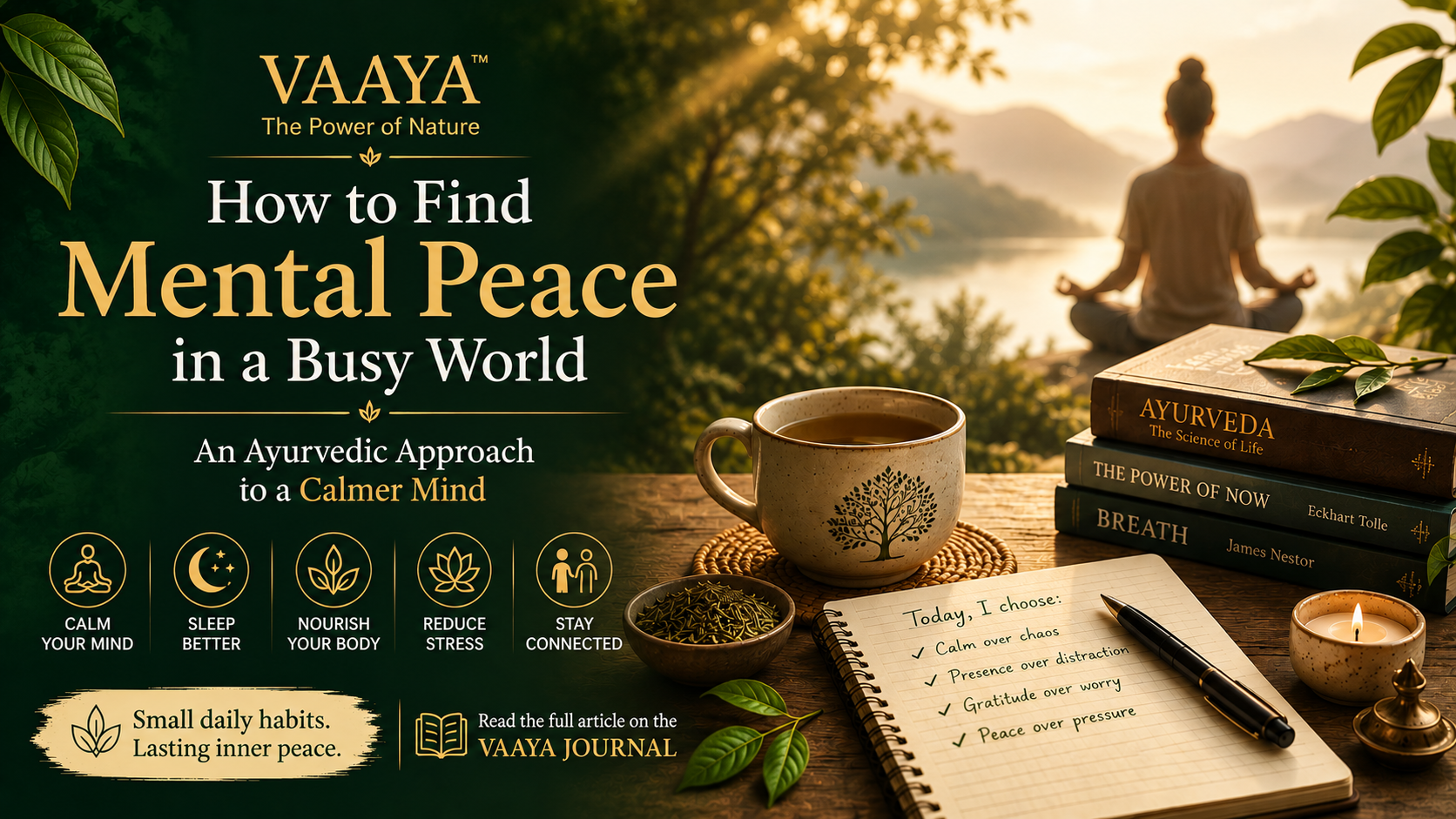
Mental peace does not mean having a life without problems, responsibilities, or difficult emotions. It means developing the ability to experience those things without allowing them to constantly disturb your sense of balance.
A calmer mind is supported by simple foundations: adequate sleep, regular movement, nourishing food, meaningful relationships, periods of quiet, mindful breathing, and a daily routine that gives the mind space to recover.
Ayurveda has traditionally placed considerable importance on balance in daily living. Modern mental-health guidance similarly emphasizes sleep, physical activity, relaxation, healthy routines, and social connection as important parts of caring for mental wellbeing.
Key Takeaways
- Mental peace is not the absence of problems; it is greater emotional stability while facing them.
- Constant stimulation can make it harder for the mind to slow down.
- Sleep is one of the most important foundations of mental wellbeing.
- Regular physical activity can support mood, sleep, and stress management.
- Slow breathing and mindfulness can create moments of mental space.
- Meaningful human connection matters.
- A simple daily routine can reduce the feeling of constantly reacting to life.
- Persistent or severe emotional distress should not be treated as something to simply “think away”; professional support may be appropriate.
What Does Mental Peace Really Mean?
We often imagine mental peace as a state in which everything is going well.
No deadlines.
No arguments.
No financial concerns.
No uncertainty.
No difficult decisions.
But that kind of life is unrealistic.
A more useful understanding of mental peace is the ability to remain grounded even when life is imperfect.
You may still have responsibilities. You may still experience disappointment, anger, sadness, or uncertainty. The difference is that these experiences do not necessarily control your entire mental space.
Mental wellbeing is an important part of overall health. The World Health Organization describes mental health as a state of wellbeing that helps people cope with the stresses of life, work effectively, learn, and contribute to their communities.
Why Does the Mind Feel So Busy?
Modern life rarely gives the mind a genuine opportunity to become quiet.
A typical day may involve:
- Messages and notifications
- Social media
- Work deadlines
- Financial decisions
- News
- Family responsibilities
- Constant multitasking
- Screens late into the evening
- Information arriving from multiple directions
The result is not necessarily that we have more problems than previous generations.
We may simply have fewer periods in which the mind is allowed to disengage from stimulation.
Mental rest therefore needs to become intentional.
1. Start With Your Daily Rhythm
A predictable daily routine can give the mind a sense of structure.
Try to keep reasonably consistent times for:
- Waking
- Meals
- Physical activity
- Work
- Relaxation
- Sleep
This does not mean every minute of the day needs to be scheduled.
In fact, excessive scheduling can become another source of stress.
The goal is simply to create a rhythm in which your mind does not have to constantly decide what comes next.
2. Make Sleep a Priority
Mental peace becomes considerably harder when the body is chronically tired.
Poor sleep can affect concentration, mood, energy, and the ability to cope with everyday stress.
Create a simple evening transition:
- Reduce unnecessary screen time before bed.
- Keep your sleeping environment comfortable and quiet.
- Avoid turning the bed into an extension of your workspace.
- Maintain a reasonably consistent sleep schedule.
- Give yourself time to mentally wind down.
Sleep should not be treated as time stolen from productivity.
It is part of the foundation that makes productivity possible.
3. Give Your Mind Moments of Silence
Not every empty moment needs to be filled.
Try spending a few minutes each day without:
- Scrolling
- Watching videos
- Checking messages
- Listening to podcasts
- Reading news
Sit quietly.
Take a walk without your phone.
Drink your morning tea without opening social media.
Look outside a window.
These moments may seem insignificant, but they create something increasingly valuable: mental space.
4. Use Your Breath to Slow Down
Breathing is one of the simplest ways to deliberately introduce a pause into a stressful moment.
When you notice yourself becoming tense, try slowing your breathing rather than immediately reacting to the situation.
For example:
Inhale gently.
Pause briefly.
Exhale slowly.
Repeat for a few minutes.
The objective is not to force yourself to “stop thinking.”
It is simply to shift attention from the stream of thoughts toward something concrete happening in the present moment.
Mindfulness and relaxation practices are among the approaches recommended in modern stress-management guidance.
5. Move Your Body
Mental wellbeing is not separate from physical wellbeing.
Walking, yoga, cycling, swimming, strength training, sports, or simply moving more throughout the day can support both physical and mental health.
You do not necessarily need an elaborate workout.
A regular walk can be a valuable beginning.
Physical activity has been associated with improved mood, better sleep, and reduced symptoms of anxiety and depression.
The best form of movement is often the one you can continue consistently.
6. Be Careful About What You Consume Mentally
Food is not the only thing we consume.
We also consume information.
If you spend hours every day consuming:
- Negative news
- Online arguments
- Comparison-driven social media
- Constant notifications
- Fear-based content
your mind may remain in a state of continuous stimulation.
Try creating boundaries.
You do not need to know everything happening in the world at every moment.
Being informed is valuable.
Being permanently stimulated is different.
7. Eat in a Way That Supports the Whole Body
There is no single food that creates mental peace.
However, regular and balanced nutrition is part of taking care of the body that the mind depends upon.
Focus on:
- Whole foods
- Adequate protein
- Fruits and vegetables
- Healthy sources of fat
- Sufficient fluids
- Regular meals
Also pay attention to how caffeine affects you.
Some people are particularly sensitive to caffeine and may notice increased restlessness, anxiety, or difficulty sleeping when intake is high or consumed too late in the day.
Mental wellbeing is rarely built from one ingredient.
It is built from patterns.
8. Stay Connected
Mental peace does not require isolation.
In fact, meaningful relationships can provide emotional support during difficult periods.
Make time for people with whom you can:
- Speak honestly
- Laugh
- Share concerns
- Spend time without performing
- Feel accepted
Sometimes the most therapeutic sentence is simply:
“I've been having a difficult week.”
You do not always need someone to solve the problem.
Sometimes being heard is enough to make the problem feel less heavy.
9. Stop Expecting Yourself to Be Positive All the Time
One of the biggest misunderstandings about mental wellness is the belief that we should always remain positive.
Real emotional wellbeing includes the ability to experience uncomfortable emotions without judging yourself for having them.
You can be grateful and still be tired.
You can be successful and still feel anxious.
You can love your life and still have difficult days.
Mental peace does not require pretending that everything is fine.
It requires learning how to acknowledge what you feel without allowing every emotion to become a permanent identity.
10. Create a Small Evening Ritual
A simple evening ritual can help signal that the day is ending.
It could include:
- A warm, non-caffeinated drink
- Gentle stretching
- Reading
- A few minutes of breathing
- Writing down tomorrow's priorities
- Reflecting on something you appreciated during the day
- Sitting quietly
The ritual does not need to be complicated.
Its purpose is to create a transition between doing and resting.
An Ayurvedic Perspective on Mental Balance
Ayurveda traditionally views wellbeing through the lens of balance between the body, mind, senses, environment, and daily habits.
Concepts such as Dinacharya emphasize the importance of a disciplined and balanced daily routine.
The broader lesson remains relevant even when viewed outside a strictly Ayurvedic framework:
Your habits influence your state.
When sleep becomes irregular, meals become chaotic, movement disappears, stimulation increases, and recovery gets neglected, the mind can become increasingly difficult to settle.
Conversely, simple and consistent routines can create a more stable foundation.
Ayurveda does not need to be approached as a collection of quick fixes.
Its more enduring value may lie in the emphasis on living with rhythm, moderation, awareness, and balance.
A Simple 15-Minute Mental Peace Routine
If your day is extremely busy, start small.
Try this:
5 Minutes — Quiet
Sit somewhere comfortable.
Put your phone away.
Simply notice your breathing and surroundings.
5 Minutes — Movement
Walk slowly or perform gentle stretches.
Let your attention move away from your thoughts and toward your body.
5 Minutes — Reflection
Ask yourself:
What is actually important today?
What can wait?
What is within my control?
What can I let go of for now?
Fifteen minutes may not solve every problem.
But it can create a pause between stimulus and reaction.
And sometimes that pause is exactly what we need.
When Mental Rest Is Not Enough
Lifestyle practices can support mental wellbeing, but they are not a substitute for professional care when someone is struggling with a mental-health condition.
Consider speaking with a qualified healthcare or mental-health professional if symptoms are persistent, worsening, or interfering with everyday life.
Signs that deserve attention can include:
- Persistent sadness or hopelessness
- Severe or ongoing anxiety
- Significant sleep disturbance
- Major changes in appetite or weight
- Loss of interest in activities you normally enjoy
- Difficulty concentrating
- Difficulty performing normal responsibilities
- Persistent irritability or emotional distress
Seeking help is not a sign of weakness.
It is a form of self-care.
Frequently Asked Questions
Is mental peace possible in a stressful life?
Yes. Mental peace does not require eliminating every source of stress. The goal is to develop healthier ways of responding to stress while addressing problems that can actually be changed.
Does meditation create mental peace?
Meditation and mindfulness practices can help some people develop greater awareness and relaxation. They are useful tools, but they are not the only route to mental wellbeing.
Can exercise improve mental wellbeing?
Regular physical activity can support mood, sleep, energy, and overall wellbeing. Even moderate activities such as walking can be a useful starting point.
How much sleep is important for mental wellbeing?
Adults generally benefit from adequate, regular sleep. Individual needs vary, but maintaining a consistent sleep routine is an important part of caring for both physical and mental health.
Does Ayurveda help with stress?
Ayurvedic traditions emphasize balanced routines, rest, mindful practices, appropriate diet, and harmony between body and mind. These practices may complement a healthy lifestyle, but persistent mental-health symptoms should be evaluated by an appropriately qualified professional.
How can I calm my mind before sleeping?
Try creating a consistent wind-down period. Reduce stimulating screen use, dim the environment, practise gentle breathing or stretching, and avoid turning bedtime into a period for solving tomorrow's problems.
Final Thoughts
Mental peace is rarely created in one dramatic moment.
It is built quietly.
One better night of sleep.
One walk.
One honest conversation.
One meal eaten mindfully.
One evening without endless scrolling.
One decision to stop worrying about something that is outside your control.
One moment of simply sitting still.
The mind does not always need another solution.
Sometimes it needs space.
At Vaaya, we believe wellness is not about chasing perfection. It is about creating sustainable habits that allow the body and mind to function with greater balance, awareness, and resilience.
Quality & Transparency
This article is intended for general educational and wellness purposes only and should not be considered medical advice, diagnosis, or treatment. Mental-health concerns can have many causes, and individual needs vary. If you are experiencing persistent or severe emotional distress, consult a qualified healthcare or mental-health professional.
About Vaaya
At Vaaya, we believe that authentic wellness begins with trust.
Our approach is inspired by the wisdom of Ayurveda while respecting the importance of modern scientific understanding and responsible wellness practices.
We believe better health is not created through extremes.
It is built through consistent choices, informed decisions, and a deeper connection with the natural foundations of wellbeing.
Sources
World Health Organization (WHO) — Mental Health https://www.who.int/health-topics/mental-health
World Health Organization (WHO) — Stress https://www.who.int/en/news-room/questions-and-answers/item/stress
World Health Organization (WHO) — Self-care for health and well-being https://www.who.int/news-room/fact-sheets/detail/self-care-health-interventions
National Institute of Mental Health (NIMH) — Caring for Your Mental Health https://www.nimh.nih.gov/health/topics/caring-for-your-mental-health
National Institute of Mental Health (NIMH) — My Mental Health: Do I Need Help? https://www.nimh.nih.gov/health/publications/my-mental-health-do-i-need-help
Begin your Shilajit ritual
Vaaya Shilajit is sourced from high-altitude Himalayan rock, purified the traditional Ayurvedic way, and lab-tested for heavy metals. Whether you start with the pure resin, the gold resin, or the travel-friendly capsules, consistency is what changes how you feel.
Questions? Write to us at care@vaayaayurveda.com
Related reading
 Everyday Wellness28 Sept 202610 min read
Your Body Has a Clock: How Daily Routines Affect Your Health
Your body follows a natural 24-hour rhythm that influences when you feel awake, sleepy, hungry and ready to rest. Discover how everyday habits such as morning light, meal timing, movement and consistent sleep can help support your body's internal clock.
Read article Digestive Wellness7 Sept 202611 min read
Dietary Fibre: Why Your Gut Needs More Than Just Roughage
Dietary fibre is more than something that keeps digestion moving. From whole grains and pulses to fruits, vegetables, nuts and seeds, fibre-rich foods can support digestive health and form an important part of a balanced diet.
Read article Healthy Ageing5 Sept 202610 min read
Healthy Ageing: 8 Everyday Habits That Help You Age Well
Ageing is inevitable, but how we age is influenced by many factors. Discover eight practical habits that can support physical health, mental wellbeing, mobility and independence as you grow older.
Read article