
Herbal Hair Colour: Can Ayurvedic Ingredients Colour Your Hair Naturally?
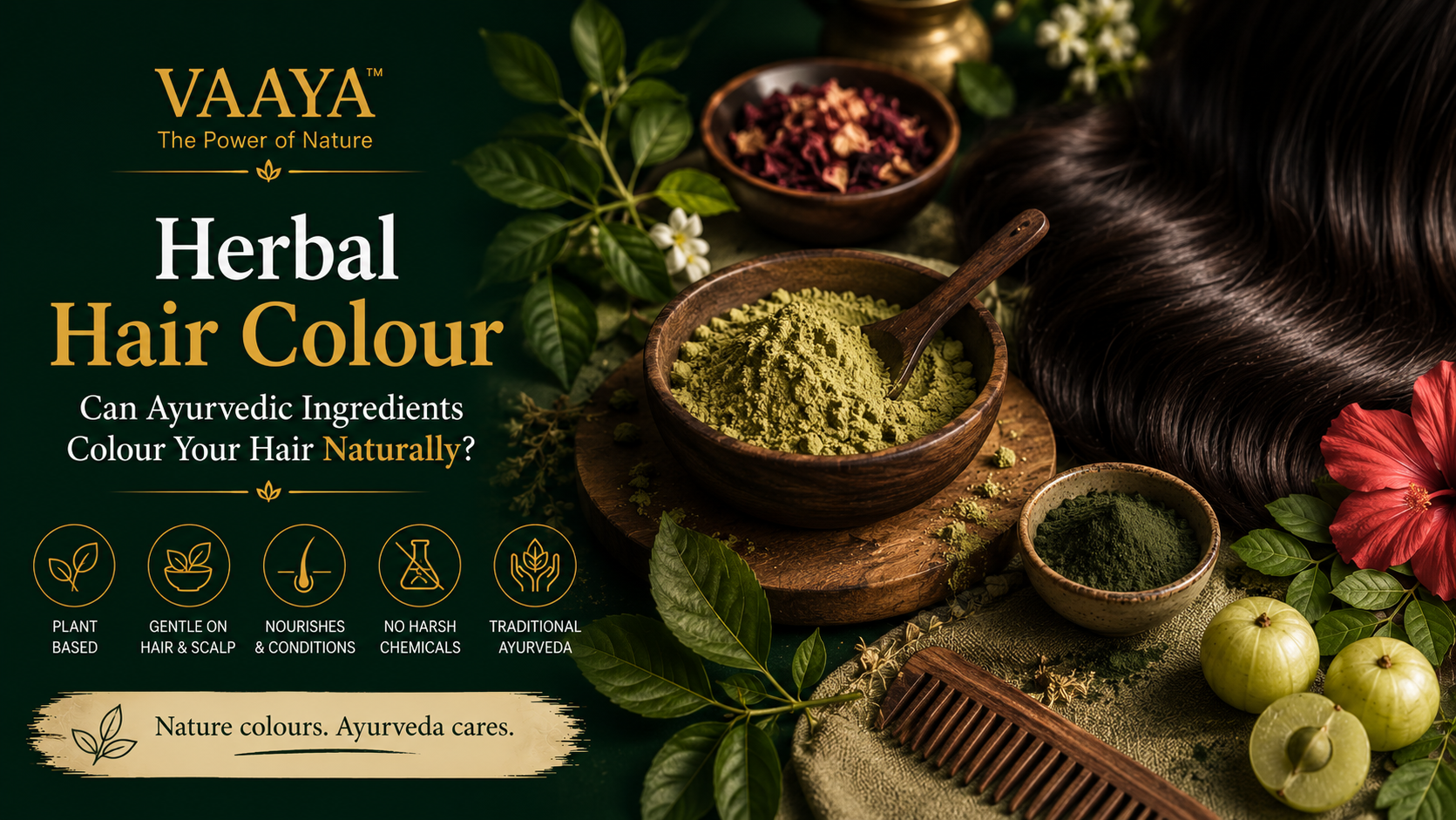
Herbal hair colour uses plant-based ingredients to deposit colour onto the hair rather than relying on the oxidative dye systems commonly found in permanent chemical hair dyes.
Henna and indigo are two of the best-known traditional colouring plants. Henna can produce warm copper, auburn or reddish-brown tones, while indigo can contribute deeper brown to blue-black shades when used appropriately.
However, "herbal" does not automatically mean that every product is safe, chemical-free or suitable for everyone. The actual ingredients, formulation, sourcing, processing and testing matter.
If you are considering a herbal hair colour, choose a product with a complete ingredient list, avoid products containing undisclosed dyes or additives, and perform a patch test according to the manufacturer's instructions.
Key Takeaways
- Herbal hair colours primarily use plant-derived colouring ingredients.
- Henna and indigo are among the most widely used traditional hair-colouring plants.
- Herbal colour generally works differently from permanent oxidative hair dye.
- Results depend on your natural hair colour, existing treatments, application method and the ingredients used.
- "Natural" is not automatically synonymous with safe or allergen-free.
- A complete ingredient list and quality testing are important when choosing a herbal hair colour.
- Always perform a patch test before applying a new colouring product.
Why Are More People Looking at Herbal Hair Colour?
Hair colouring has become a normal part of modern grooming.
People colour their hair to cover grey, change their appearance, add depth or simply experiment with a new look.
At the same time, some people are becoming more conscious of the ingredients they use on their hair and scalp.
This has increased interest in plant-based alternatives.
Herbal hair colour offers a different approach: instead of depending entirely on synthetic colouring chemistry, it uses pigments derived from plants and other naturally sourced ingredients.
The important distinction is that the word "herbal" describes the ingredient philosophy. It does not, by itself, guarantee a particular safety profile.
How Does Herbal Hair Colour Work?
The mechanism depends on the plants used.
Henna, derived from the leaves of Lawsonia inermis, contains a natural pigment called lawsone.
Lawsone binds to keratin, the protein that makes up much of the hair fibre, creating a characteristic warm orange-red colour.
Indigo, derived from Indigofera tinctoria, contains pigments that can produce deeper blue tones. When used alongside or after henna, it can create shades ranging from brown to very dark brown and black depending on the starting hair colour and application method.
Unlike permanent oxidative hair dyes, traditional henna and indigo do not work by the same process of chemically lightening the hair and then developing an artificial pigment inside the hair shaft.
Instead, the plant pigments primarily coat and bind to the hair fibre.
Henna: The Traditional Colouring Herb
Henna has been used for centuries across South Asia, the Middle East and North Africa for hair and body decoration.
For hair, pure henna generally produces shades within a warm spectrum:
- Copper
- Auburn
- Reddish brown
- Deep warm brown
The final result depends heavily on the original hair colour.
On dark hair, henna may appear primarily as a warm reddish or copper highlight rather than dramatically changing the overall colour.
On grey or lighter hair, the colour can appear considerably brighter.
This is why two people can use the same henna preparation and obtain noticeably different results.
Indigo for Deeper Shades
Indigo is particularly interesting when the goal is a darker result.
Used alone, indigo can produce blue or blue-green tones on light hair. This is why it is commonly combined with henna or used after a henna application.
The sequence, proportions, preparation and processing time can influence the final shade.
Because plant-based colour interacts with the existing hair colour, achieving a specific salon-style shade can be less predictable than using a professionally formulated permanent dye.
Herbal Hair Colour vs Conventional Hair Dye
The two approaches are fundamentally different.
Conventional permanent hair dyes commonly use an oxidative process involving ingredients such as dye precursors and an alkalising agent, often with hydrogen peroxide as the developer.
Traditional henna-based colouring works through plant pigments binding to the hair.
This difference can affect:
- Colour development
- Grey coverage
- Longevity
- Ability to lighten hair
- Final shade
- Colour predictability
- Compatibility with previously treated hair
Herbal colouring generally cannot be expected to behave exactly like conventional permanent dye.
That is not necessarily a disadvantage—it simply means expectations should be realistic.
Can Herbal Hair Colour Cover Grey Hair?
It can.
Henna and henna-indigo systems are traditionally used for grey coverage, but the result depends on the amount of grey, the natural hair colour, the formulation and the application process.
Grey hair often takes up plant pigments differently from heavily pigmented hair.
A two-step henna-and-indigo process is sometimes used when a deeper brown or black appearance is desired.
For significant grey coverage, following the specific instructions supplied with the product is important.
Will Herbal Hair Colour Damage Hair?
It is tempting to assume that a plant-based product cannot damage hair.
That conclusion is too broad.
Pure henna is generally considered a conditioning-type colouring ingredient for many users, but commercial "herbal" hair colours may contain multiple ingredients.
The effect on hair depends on the complete formulation.
Repeated colouring, excessive processing, incompatible treatments and poor-quality ingredients can all affect hair appearance and texture.
The safest approach is to evaluate the actual product rather than relying only on the word "herbal" on the packaging.
What About "Black Henna"?
This is particularly important.
"Black henna" is not necessarily the same thing as traditional pure henna.
Products marketed as black henna may contain additional colouring substances, including para-phenylenediamine (PPD), which can cause significant allergic reactions in some people.
A product that promises extremely dark or instant black colour should therefore be examined carefully.
Read the ingredient list.
If the ingredients are not clearly disclosed, it is better to choose another product.
How to Choose a Good Herbal Hair Colour
Before purchasing a herbal hair colour, look for:
A Complete Ingredient List
You should be able to identify what you are actually putting on your hair and scalp.
Clearly Identified Plant Ingredients
If henna, indigo, amla or other herbs are used, the product should clearly state them.
Quality Testing
Choose brands that demonstrate appropriate quality control and testing rather than making vague claims about being "100% natural."
No Undisclosed Colouring Agents
Be cautious about products that make dramatic colour claims without clearly explaining their formulation.
Clear Instructions
A responsible product should explain preparation, application time, precautions and patch testing.
A Simple Herbal Hair Colour Routine
If you are using a new herbal colouring product, keep the first application simple.
- Read the complete ingredient list.
- Follow the manufacturer's preparation instructions.
- Perform the recommended patch test.
- Apply a small amount to a less noticeable section of hair first if possible.
- Observe the colour before committing to a full application.
- Follow the recommended processing time.
- Rinse thoroughly.
Do not assume that leaving a product on for significantly longer will necessarily produce a better result.
What Can Influence the Final Colour?
The final shade is affected by several factors:
- Natural hair colour
- Percentage of grey hair
- Previous chemical colouring
- Hair porosity
- Plant ingredients used
- Mixing method
- Processing time
- Frequency of application
This is why herbal hair colour is best approached as a gradual colouring process rather than an exact colour formula.
Can You Use Herbal Colour on Chemically Treated Hair?
Sometimes, but caution is advisable.
If your hair has recently been bleached, chemically straightened, permed or coloured, its structure may already be altered.
Different products can also interact unpredictably.
Always check the manufacturer's compatibility guidance and consider testing a small section of hair before applying the product to your entire head.
If your hair has undergone extensive chemical treatment, professional advice can be useful.
Ayurveda and Hair Colouring
Ayurvedic hair care has traditionally included a wide variety of herbs and plant preparations for maintaining hair and scalp wellbeing.
Ingredients such as amla, bhringraj, hibiscus, neem and fenugreek are frequently associated with traditional Ayurvedic hair-care practices.
However, not every traditional herb is a colouring agent.
This distinction matters.
An ingredient can be traditionally used for hair care without necessarily changing the colour of the hair.
When choosing an Ayurvedic or herbal hair colour, therefore, look specifically at the ingredients responsible for pigmentation rather than assuming that every herb in the formulation will contribute to colour.
Common Mistakes to Avoid
Choosing a Product Solely Because It Says "Natural"
Natural is not a substitute for ingredient transparency and quality control.
Skipping the Patch Test
Plant ingredients can still cause irritation or allergic reactions.
Expecting Salon-Like Colour in One Application
Plant pigments behave differently from conventional oxidative dyes.
Ignoring Your Existing Hair Colour
The same product can look completely different on black, brown and grey hair.
Using an Unverified "Black Henna"
Always check the ingredient list and avoid products with undisclosed colouring agents.
Frequently Asked Questions
Is herbal hair colour completely chemical-free?
The phrase "chemical-free" is scientifically misleading because everything is made of chemicals. What matters is which ingredients are used and whether the product is properly formulated and tested.
Is henna good for covering grey hair?
Henna can colour grey hair, often producing warm copper, orange or reddish tones. For darker shades, henna is commonly combined with indigo.
Does herbal hair colour permanently change hair colour?
Traditional plant colours can be long-lasting because pigments bind to the hair fibre, but they generally behave differently from permanent oxidative dyes and gradually change in appearance with washing and new hair growth.
Can herbal hair colour make black hair brown?
Pure henna generally does not lighten naturally dark hair. It can add warm reddish or copper undertones that become more visible in sunlight.
Is herbal hair colour safe for sensitive scalps?
Not necessarily. Any topical product can cause irritation or allergy in susceptible individuals. Patch testing and careful ingredient selection are important.
How often can I colour my hair with henna?
There is no single frequency suitable for everyone. Follow the product instructions and consider the condition of your hair, scalp and previous treatments.
Can I use herbal hair colour after chemical colouring?
Compatibility depends on the specific products involved. If your hair has been bleached, straightened, permed or recently coloured, test a small section first and follow the manufacturer's guidance.
Final Thoughts
Herbal hair colour is not simply a trend.
Plants such as henna and indigo have a long history of use for colouring hair, and they offer an alternative approach to conventional hair dyes.
But choosing natural colouring should not mean choosing blindly.
Look beyond the front of the package.
Check the ingredients.
Understand what colour the plants can realistically produce.
Patch test before use.
And choose a product from a brand that is willing to be transparent about what goes into it.
The best hair-care choices are not necessarily the ones with the biggest promises.
They are the ones you can understand and trust.
Quality & Transparency
This article is intended for educational purposes only and should not be considered medical advice. Individual responses to hair-colouring products vary. Always follow the manufacturer's instructions and perform the recommended patch test before use.
If you develop significant irritation, swelling, burning or other concerning symptoms after using a hair-colouring product, discontinue use and seek appropriate medical attention.
About Vaaya
At Vaaya, we believe that authentic wellness begins with trust.
Our approach draws inspiration from Ayurveda while keeping modern quality, transparency and informed choices at the centre of the wellness journey.
The Power of Nature.
Sources
National Center for Complementary and Integrative Health (NCCIH) — Ayurvedic Medicine: https://www.nccih.nih.gov/health/ayurvedic-medicine-in-depth
U.S. Food & Drug Administration (FDA) — Hair Dyes: https://www.fda.gov/cosmetics/cosmetic-products/hair-dyes
PubMed — Research literature on henna, lawsone and hair: https://pubmed.ncbi.nlm.nih.gov/
National Center for Biotechnology Information (NCBI): https://www.ncbi.nlm.nih.gov/
Begin your Shilajit ritual
Vaaya Shilajit is sourced from high-altitude Himalayan rock, purified the traditional Ayurvedic way, and lab-tested for heavy metals. Whether you start with the pure resin, the gold resin, or the travel-friendly capsules, consistency is what changes how you feel.
Questions? Write to us at care@vaayaayurveda.com
Related reading
 Everyday Wellness28 Sept 202610 min read
Your Body Has a Clock: How Daily Routines Affect Your Health
Your body follows a natural 24-hour rhythm that influences when you feel awake, sleepy, hungry and ready to rest. Discover how everyday habits such as morning light, meal timing, movement and consistent sleep can help support your body's internal clock.
Read article Digestive Wellness7 Sept 202611 min read
Dietary Fibre: Why Your Gut Needs More Than Just Roughage
Dietary fibre is more than something that keeps digestion moving. From whole grains and pulses to fruits, vegetables, nuts and seeds, fibre-rich foods can support digestive health and form an important part of a balanced diet.
Read article Healthy Ageing5 Sept 202610 min read
Healthy Ageing: 8 Everyday Habits That Help You Age Well
Ageing is inevitable, but how we age is influenced by many factors. Discover eight practical habits that can support physical health, mental wellbeing, mobility and independence as you grow older.
Read article