
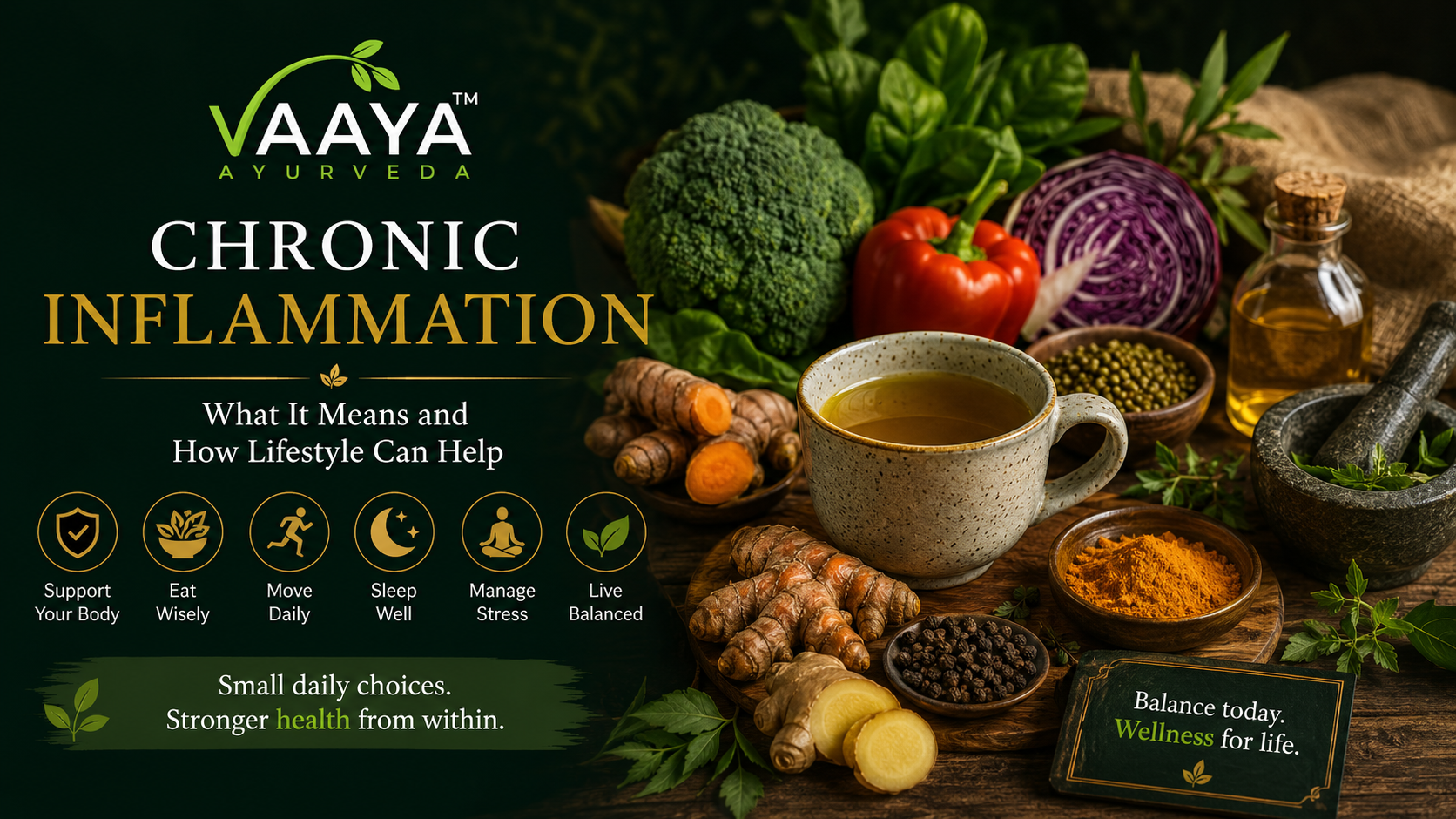
Chronic Inflammation: What It Means and How Lifestyle Can Help
Inflammation is not inherently bad.
It is one of the body's natural defence mechanisms and plays an important role when the body responds to injury, infection or other threats.
The concern is chronic inflammation—when inflammatory activity persists over a long period and becomes associated with a range of health problems.
Lifestyle cannot eliminate all inflammation, and no single food or supplement can "switch off" inflammation.
However, healthy habits can support overall metabolic and immune health.
A balanced diet rich in minimally processed foods, regular physical activity, sufficient sleep, stress management, maintaining a healthy body weight and avoiding tobacco are among the most useful foundations.
Ayurveda has traditionally emphasised balance, digestion, daily routine and appropriate diet as important components of wellbeing. These principles can complement—but should not replace—modern medical care.
Key Takeaways
- Inflammation is a normal and necessary biological response.
- Acute inflammation can help the body respond to injury and infection.
- Chronic inflammation is different and may persist for prolonged periods.
- Diet, physical activity, sleep, stress and body composition can influence overall inflammatory health.
- There is no single "anti-inflammatory" food that can solve the problem.
- A diet based largely on whole and minimally processed foods is a better long-term strategy than extreme elimination diets.
- Turmeric, ginger and other herbs can be part of a healthy diet, but food should not be confused with medical treatment.
- Persistent symptoms should be evaluated rather than automatically attributed to inflammation.
What Is Inflammation?
Inflammation is part of the body's protective response.
When you cut your finger, for example, the surrounding area may become red, warm and swollen.
That reaction is not necessarily a problem.
It is evidence that the body is responding to damage and beginning the process of repair.
This type of short-term response is known as acute inflammation.
The problem is different when inflammatory processes remain active for a prolonged period.
That is generally referred to as chronic inflammation.
Unlike the obvious redness and swelling that can accompany an injury, chronic inflammation may be much less visible.
Acute vs Chronic Inflammation
Understanding the difference is important.
Acute Inflammation
Acute inflammation develops relatively quickly and is usually associated with a specific event.
Examples include:
- A cut
- An injury
- An infection
- A burn
It is generally a short-term response.
Chronic Inflammation
Chronic inflammation develops or persists over a much longer period.
It can be associated with a variety of conditions and lifestyle factors.
Importantly, chronic inflammation is not a diagnosis that should be made simply because you feel tired, bloated or achy.
Many symptoms have multiple possible causes.
Proper medical evaluation matters.
What Can Influence Chronic Inflammation?
Inflammation is influenced by far more than what you eat.
Factors that can contribute to overall inflammatory health include:
- Excess body fat
- Physical inactivity
- Smoking
- Poor sleep
- Chronic stress
- Excessive alcohol consumption
- Certain dietary patterns
- Infections
- Autoimmune conditions
- Other underlying diseases
This is why looking for one "anti-inflammatory" ingredient can be misleading.
Your lifestyle operates as a system.
Food and Inflammation
Food is one of the most discussed areas of inflammation—and also one of the most misunderstood.
There is no universally perfect anti-inflammatory diet.
However, dietary patterns that emphasise minimally processed foods are generally associated with better overall health.
Build meals around foods such as:
- Vegetables
- Fruits
- Whole grains
- Pulses
- Beans
- Nuts
- Seeds
- Fish, where appropriate
- Other nutritious protein sources
At the same time, it can be useful to reduce excessive consumption of highly processed foods, particularly those high in added sugars, unhealthy fats and excess calories.
The goal is not perfection.
It is the overall pattern.
The Role of Colourful Foods
A simple way to improve dietary variety is to eat a wider range of naturally colourful foods.
Different fruits and vegetables contain different combinations of vitamins, minerals and plant compounds.
Think:
🥕 Carrots
🥦 Broccoli
🍅 Tomatoes
🫐 Berries
🥬 Leafy greens
🫑 Peppers
🧅 Onions
Instead of searching for a single superfood, create a plate containing several different foods.
Variety is more useful than hype.
Turmeric and Inflammation
Turmeric is one of the most widely discussed spices in the context of inflammation.
Its major bioactive compound, curcumin, has been studied extensively for its biological effects.
This has led to a huge market for curcumin supplements.
But there is an important distinction.
Research investigating concentrated curcumin preparations should not automatically be interpreted as proof that adding a small amount of turmeric to food will treat a medical condition.
Turmeric can certainly be part of a healthy diet.
But it should not be presented as a replacement for medical treatment.
Ginger and Other Traditional Herbs
Ginger has a long history of culinary and traditional use.
Other herbs and spices commonly used in Indian kitchens include:
- Cumin
- Coriander
- Fennel
- Cinnamon
- Garlic
- Black pepper
These ingredients add flavour and plant compounds to everyday meals.
That is a useful reason to include them.
But traditional use and modern medical treatment are not the same thing.
If you are considering concentrated herbal supplements, particularly while taking medication, professional advice is appropriate.
Exercise and Inflammation
Physical activity is one of the most powerful lifestyle tools available for overall health.
Regular exercise supports:
- Cardiovascular health
- Muscle strength
- Insulin sensitivity
- Healthy body composition
- Mental wellbeing
- Functional fitness
Exercise itself can temporarily produce an inflammatory response.
That does not mean exercise is harmful.
The body responds to physical stress and then adapts.
The important distinction is between the short-term response to exercise and the broader health benefits of maintaining regular physical activity.
You Don't Need Extreme Workouts
You do not have to train for a marathon.
A sustainable routine can include:
- Walking
- Cycling
- Swimming
- Yoga
- Strength training
- Playing a sport
- Short daily movement breaks
The best exercise routine is one you can maintain.
Consistency beats intensity when intensity cannot be sustained.
Sleep and Inflammation
Sleep is another important part of the picture.
Poor sleep can affect immune function, appetite regulation, glucose metabolism, mood and many other aspects of health.
If your goal is to improve your overall inflammatory and metabolic health, sacrificing sleep to spend more time exercising or preparing elaborate meals may be counterproductive.
Prioritise sufficient, regular sleep.
Your body needs recovery.
Stress Is Not "Just in Your Head"
Stress affects the body as well as the mind.
Short-term stress is a normal response that helps you deal with challenges.
Persistent psychological stress, however, can influence sleep, appetite, physical activity and other physiological processes.
This does not mean every stressful day is damaging your health.
Life will always contain stress.
The objective is to build ways of recovering from it.
Useful options include:
- Walking
- Meditation
- Breathing exercises
- Yoga
- Time outdoors
- Social connection
- Hobbies
- Adequate sleep
- Taking meaningful breaks from work
There is no universal best method.
Choose something you can actually practise.
Body Weight and Inflammation
Excess body fat, particularly visceral fat around the internal organs, is associated with metabolic and inflammatory processes.
This is one reason maintaining a healthy body weight can be beneficial for overall health.
But this does not mean that you need to pursue rapid weight loss.
Extreme diets can be difficult to sustain and may create nutritional problems.
A better approach is gradual improvement in:
- Food quality
- Portion awareness
- Physical activity
- Muscle mass
- Sleep
- Stress management
Health is not simply a number on a weighing scale.
Ayurveda and the Concept of Balance
Ayurveda approaches health through a broader framework of balance.
Traditional Ayurvedic thinking places importance on digestion, food, daily routine, sleep, seasonal changes and individual constitution.
Concepts such as Agni are used to describe digestive and metabolic processes within the Ayurvedic system.
Modern medicine describes inflammation through a very different scientific framework involving immune cells, signalling molecules and physiological pathways.
These systems should not be presented as interchangeable.
However, many practical lifestyle principles—such as eating appropriately, maintaining routine, staying active and prioritising rest—can fit comfortably within a modern wellness approach.
What Does an Anti-Inflammatory Day Look Like?
It does not need to be complicated.
Morning
Begin with hydration.
Get some natural daylight.
Move your body, even if it is only a short walk.
Breakfast
Choose a balanced meal containing nutritious carbohydrates, protein and fibre according to your individual needs.
Lunch
Build your plate around vegetables, a protein source and a minimally processed carbohydrate.
Use herbs and spices to add flavour.
Afternoon
Stay active.
Avoid spending the entire day sitting continuously.
Dinner
Choose a satisfying meal rather than relying on an extreme "clean eating" plan.
If heavy late-night meals affect your sleep or digestion, consider eating earlier.
Night
Reduce stimulation.
Create a consistent bedtime routine.
Get enough sleep.
That is already a powerful wellness routine.
Common Myths About Inflammation
"All Inflammation Is Bad."
No.
Inflammation is an essential part of the body's defence and repair processes.
The concern is inappropriate or persistent inflammation.
"You Need an Anti-Inflammatory Detox."
There is no need for most healthy people to undertake extreme detox diets.
Your body already has sophisticated systems for processing nutrients and eliminating waste.
"Turmeric Will Remove Inflammation."
Turmeric contains compounds that have been studied for their biological effects, but eating turmeric should not be confused with treating a medical inflammatory condition.
"If You Feel Tired, You Have Chronic Inflammation."
Fatigue has many possible causes.
It should not automatically be attributed to inflammation.
"Gluten Causes Inflammation in Everyone."
Gluten is a genuine concern for people with conditions such as coeliac disease, but there is no general reason for everyone to eliminate gluten.
"An Expensive Supplement Is the Fastest Solution."
A supplement cannot compensate for chronic sleep deprivation, inactivity, smoking or a poor overall diet.
When Should You Speak to a Healthcare Professional?
Inflammation is a biological process, not simply a feeling.
Persistent symptoms should not be self-diagnosed as "inflammation."
Speak with a healthcare professional if you experience symptoms such as:
- Persistent or unexplained pain
- Recurrent fever
- Unexplained weight loss
- Persistent digestive problems
- Significant fatigue
- Unexplained swelling
- Recurrent symptoms that interfere with daily life
The appropriate evaluation depends on the symptoms and your individual circumstances.
Frequently Asked Questions
What is the best food for inflammation?
There is no single best food. A varied dietary pattern rich in vegetables, fruits, whole grains, pulses, nuts, seeds and other minimally processed foods is a more useful long-term approach.
Is turmeric an anti-inflammatory?
Turmeric contains curcumin, which has been investigated for potential biological and anti-inflammatory effects. However, turmeric should not be considered a treatment for inflammatory disease.
Does exercise reduce inflammation?
Regular physical activity is associated with many health benefits and can support metabolic health. Exercise can also cause a temporary physiological inflammatory response, which is part of normal adaptation.
Does sugar cause inflammation?
Excessive intake of added sugars can contribute to poor dietary quality, excess calorie intake and metabolic problems. It is more useful to consider the overall dietary pattern than to label one ingredient as the sole cause of inflammation.
Does poor sleep increase inflammation?
Insufficient or poor-quality sleep is associated with changes in immune and inflammatory processes. Consistently adequate sleep is therefore an important component of overall health.
Can Ayurveda reduce inflammation?
Ayurveda provides a traditional framework focused on balance, digestion, food and lifestyle. It should not be used as a substitute for diagnosis or treatment of inflammatory diseases.
Should I take an anti-inflammatory supplement?
Not automatically. Supplements can have side effects and may interact with medications. If you are considering a concentrated herbal or nutritional supplement, especially for a medical condition, consult a qualified healthcare professional.
Final Thoughts
Inflammation is not your enemy.
It is part of how your body protects and repairs itself.
The goal is not to eliminate inflammation.
The goal is to support the conditions in which your body can regulate its inflammatory responses appropriately.
That starts with remarkably ordinary things.
Eat a varied diet.
Move regularly.
Maintain a healthy body composition.
Sleep well.
Manage stress.
Avoid smoking.
And be cautious of products that promise to "flush out" inflammation overnight.
Ayurveda's emphasis on balance and daily routine offers a useful traditional perspective, while modern science helps us understand the complex biology behind inflammation.
Neither requires a miracle cure.
Sometimes better health comes from doing the basics consistently.
Quality & Transparency
This article is intended for educational purposes only and should not be considered medical advice. Chronic inflammation can be associated with many different medical conditions, and symptoms alone cannot establish a diagnosis.
Do not discontinue prescribed medication or replace medical treatment with dietary changes or herbal products without consulting a qualified healthcare professional.
About Vaaya
At Vaaya, we believe that authentic wellness begins with trust.
Our approach draws inspiration from Ayurveda while keeping modern quality, transparency and informed choices at the centre of the wellness journey.
The Power of Nature.
Sources
National Institute of Allergy and Infectious Diseases (NIAID) — Immune System and Inflammation: https://www.niaid.nih.gov/research/immune-system-overview
National Institute of Environmental Health Sciences (NIEHS) — Inflammation: https://www.niehs.nih.gov/health/topics/conditions/inflammation
National Center for Complementary and Integrative Health (NCCIH) — Herbs at a Glance: https://www.nccih.nih.gov/health/herbsataglance
Centers for Disease Control and Prevention (CDC) — Physical Activity: https://www.cdc.gov/physical-activity/
Centers for Disease Control and Prevention (CDC) — About Sleep: https://www.cdc.gov/sleep/about/index.html
U.S. Department of Agriculture — Dietary Guidelines for Americans: https://www.dietaryguidelines.gov/
National Center for Biotechnology Information (NCBI): https://www.ncbi.nlm.nih.gov/
PubMed: https://pubmed.ncbi.nlm.nih.gov/
Begin your Shilajit ritual
Vaaya Shilajit is sourced from high-altitude Himalayan rock, purified the traditional Ayurvedic way, and lab-tested for heavy metals. Whether you start with the pure resin, the gold resin, or the travel-friendly capsules, consistency is what changes how you feel.
Questions? Write to us at care@vaayaayurveda.com
Related reading
 Sleep & Wellness29 Aug 202611 min read
The Power of Sleep: Why Rest Is Essential for Your Health
Sleep is not simply time spent doing nothing. It is an active biological process that supports the brain, metabolism, mood, immunity and physical recovery. Learn how better sleep can become one of the simplest foundations of everyday wellness.
Read article Metabolic Health28 Aug 202611 min read
How to Support a Healthy Metabolism: What Actually Matters
Your metabolism is more than how quickly you burn calories. It is the complex network of processes that keeps your body functioning every day. Discover the practical habits that can support metabolic health without extreme diets or quick fixes.
Read article Hair & Scalp Care27 Aug 202610 min read
Herbal Hair Colour: Can Ayurvedic Ingredients Colour Your Hair Naturally?
Looking for an alternative to conventional hair dye? Discover how herbal hair colour works, the traditional Ayurvedic ingredients used to colour hair, and what to know before choosing a natural colouring option.
Read article