Ayurvedic Hair Colour: Can Herbal Hair Dyes Be a Better Alternative to Chemical Hair Colour?
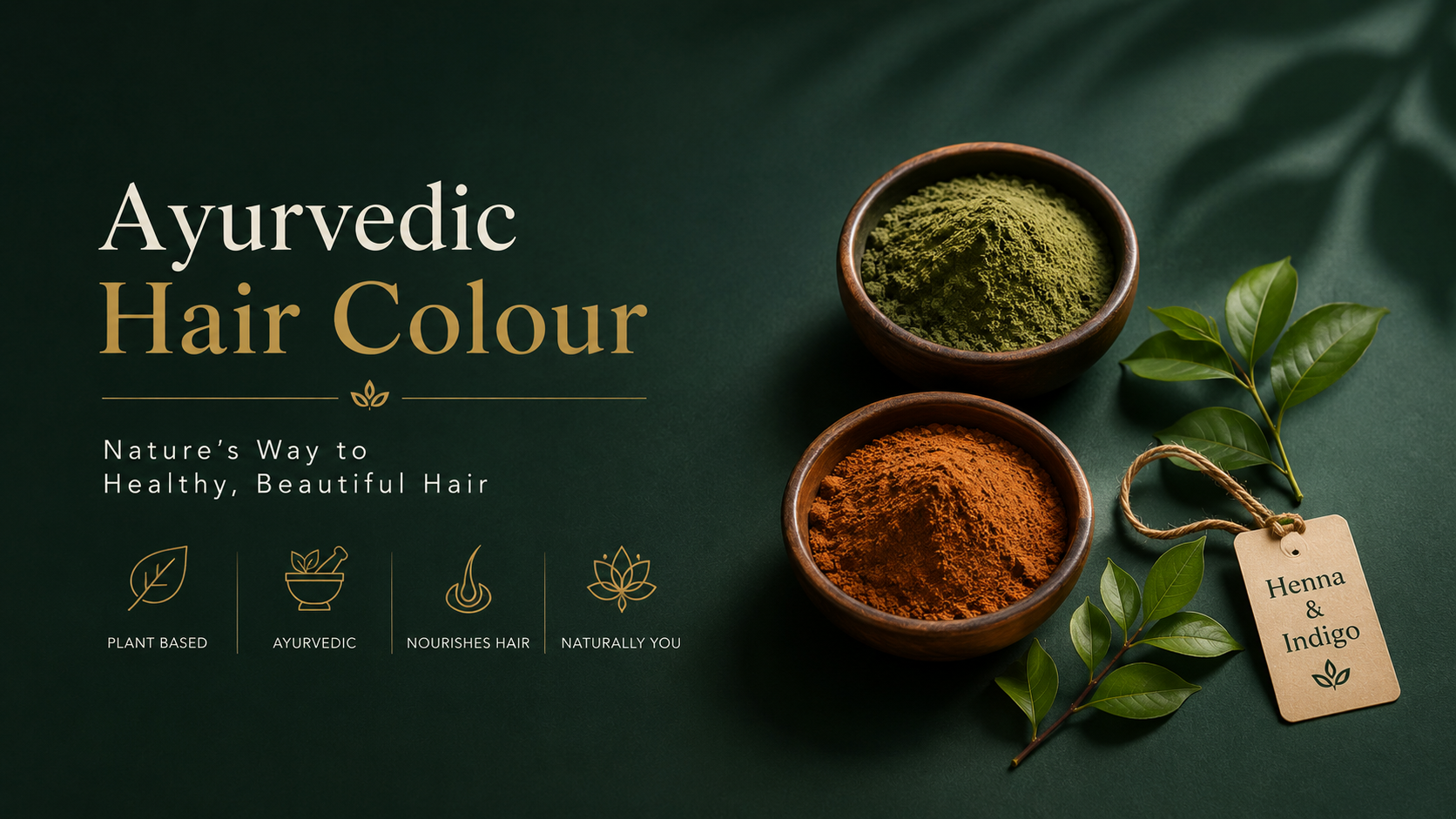
Ayurvedic and herbal hair colours can be an alternative to conventional oxidative hair dyes, particularly when they are based on clearly identified plant ingredients such as henna and indigo.
However, “natural” does not automatically mean “risk-free.”
Pure henna, derived from the Lawsonia plant, naturally produces orange, copper, or reddish-brown tones. Indigo, derived from Indigofera tinctoria, can be used alongside henna to create deeper brown and black shades.
The most important consideration is not simply whether a product is labelled Ayurvedic or herbal, but what is actually inside the product.
A transparent ingredient list, reliable manufacturing, appropriate quality testing, and a patch test are all important parts of responsible hair colouring.
Key Takeaways
- Pure henna naturally produces warm copper, red, or reddish-brown tones.
- Indigo can be combined with henna to create darker brown and black shades.
- Plant-based hair colour generally works differently from conventional oxidative dyes.
- “Herbal” or “natural” on the packaging does not guarantee that a product contains only plants.
- Some products marketed as henna or herbal hair colour may contain additional chemical colouring agents.
- PPD is a particularly important ingredient to watch for if you are trying to avoid conventional oxidative hair-dye chemistry.
- Indigo itself has been assessed by the European Scientific Committee on Consumer Safety for certain cosmetic hair-colouring uses, although a weak skin-sensitisation potential could not be excluded.
- Always read the complete ingredient list and perform the manufacturer's recommended patch test.
- Quality, transparency, and formulation matter as much as the word “Ayurvedic.”
What Is Ayurvedic Hair Colour?
Ayurvedic hair colouring traditionally relies on plants and botanical materials rather than treating hair colour as purely a cosmetic transformation.
Among the best-known natural colouring plants are:
Henna — Lawsonia inermis
Henna is one of the oldest plant-based hair-colouring materials. Its natural colour is generally warm, ranging from orange and copper to reddish-brown depending on the starting hair colour and formulation.
Henna coats and interacts with the hair fibre rather than functioning like a conventional oxidative dye that opens the hair structure and develops colour through chemical oxidation.
Indigo — Indigofera tinctoria
Indigo is a plant traditionally used to produce blue and blue-black pigments.
In hair colouring, it is commonly used together with henna. Depending on the process, proportions, and starting hair colour, the combination can produce brown, dark brown, or black shades.
The European Scientific Committee on Consumer Safety has evaluated Indigofera tinctoria for use in non-oxidative hair-colouring products and concluded that it was safe under the specified conditions of use, while noting that a weak skin-sensitisation potential could not be excluded.
Other Ayurvedic herbs
Ingredients such as amla, bhringraj, brahmi, neem, and hibiscus are frequently associated with Ayurvedic hair care.
However, it is important to distinguish between herbs traditionally used for hair and scalp care and plants that actually provide significant hair colour.
Not every herb added to a “herbal hair colour” product is a colouring agent.
How Does Henna Colour Hair?
Henna contains a naturally occurring pigment known as lawsone.
When suitable henna is applied to the hair, the pigment binds strongly to keratin, contributing a characteristic warm colour.
The final result depends on several factors:
- Natural hair colour
- Percentage of grey hair
- Previous colouring
- Henna quality
- Processing method
- Application time
- Frequency of application
This is why two people can use apparently similar henna products and obtain noticeably different results.
Henna is particularly useful for people who appreciate warm copper, auburn, or reddish-brown tones.
It should not be expected to bleach or significantly lighten naturally dark hair.
Can Henna Cover Grey Hair?
Yes, henna can colour grey hair, but the result is usually different from conventional permanent hair dye.
Grey strands have little or no natural pigment, so pure henna may make them appear noticeably copper, orange, or red.
This can actually create a natural-looking variation across the hair rather than a completely uniform colour.
For people looking for brown or black coverage, indigo is often incorporated into the colouring process.
A two-step henna-and-indigo process can produce deeper shades than henna alone.
Henna vs Indigo: What's the Difference?
| Ingredient | Botanical source | Typical colour contribution |
|---|---|---|
| Henna | Lawsonia inermis | Copper, red, auburn, warm brown |
| Indigo | Indigofera tinctoria | Brown, dark brown, blue-black |
| Amla | Phyllanthus emblica | Primarily a hair-care ingredient rather than a primary dye |
| Bhringraj | Eclipta species | Traditionally used for hair care rather than as a primary colouring pigment |
The final shade depends on the formulation and application technique.
There is no single “natural black” colour that every plant-based formula will produce.
Is Herbal Hair Colour Safer Than Chemical Hair Dye?
This question requires some nuance.
Plant-based hair colouring can avoid certain conventional dye ingredients, including PPD, when the product genuinely contains only plant-based colouring materials.
However, “herbal,” “organic,” “Ayurvedic,” and “chemical-free” are not interchangeable terms.
A product can contain botanical ingredients and still contain additional colouring chemicals.
The U.S. FDA specifically warns that products marketed as henna or “black henna” may contain additional ingredients. PPD, or p-phenylenediamine, is particularly associated with allergic reactions in hair dyes and is commonly associated with products marketed as “black henna” for skin use.
Therefore, the correct question is not:
“Is this product natural?”
It is:
“What exactly is in this product?”
Why “Black Henna” Deserves Special Attention
Pure henna naturally produces warm reddish-brown tones.
If a product promises an extremely dark or black result while simply calling itself “henna,” consumers should look carefully at the ingredient list.
Products marketed as “black henna” for skin applications have historically been associated with PPD.
PPD can cause sensitisation and allergic reactions in some individuals.
Importantly, this does not mean that every dark herbal hair-colouring product contains PPD.
It means that consumers should avoid relying on marketing terminology alone.
Check the ingredients.
What Should You Look for on a Herbal Hair Colour Label?
A good starting point is transparency.
Look for:
- Complete ingredient disclosure
- Clearly identified botanical ingredients
- Manufacturer information
- Batch or lot information
- Appropriate quality testing
- Instructions for use
- Patch-test instructions
- Clear shade information
- Manufacturing and expiry information
If a product simply says “100% herbal” but does not clearly explain what ingredients create the colour, it is reasonable to be cautious.
The more transparent the manufacturer is, the easier it is for consumers to make an informed decision.
Does “Ayurvedic” Mean Chemical-Free?
No.
This distinction is important.
Ayurveda is a traditional system of health and wellness. A product being inspired by Ayurvedic principles does not automatically mean that every ingredient in it is a plant.
Similarly, the word “herbal” does not by itself establish that a formulation contains no synthetic colouring agents.
Consumers should evaluate the actual formulation rather than relying solely on front-of-pack claims.
Can Herbal Hair Colour Damage Hair?
The effect depends heavily on the formulation and application process.
Pure plant-based colourants such as henna do not work in exactly the same way as oxidative permanent hair dyes.
However, repeated colouring, excessive processing, aggressive washing, heat styling, and poor-quality formulations can all affect how hair feels and behaves.
Another important consideration is that previously chemically treated hair can respond differently to plant-based colouring.
If your hair has been bleached, chemically straightened, relaxed, or extensively coloured, it is sensible to test the product on a small strand before applying it throughout the scalp.
Patch Testing Still Matters
A common misconception is:
“It is herbal, so I don't need a patch test.”
That is not a safe assumption.
Botanical ingredients can also cause irritation or sensitisation in susceptible individuals.
The FDA recommends following the manufacturer's safety instructions and performing a skin test before using hair dye.
A patch test does not guarantee that a reaction cannot occur, but it is an important precaution.
If you have previously experienced a reaction to hair dye, speak with a healthcare professional before trying another colouring product.
How to Make Herbal Hair Colour Part of a Better Hair Routine
Hair colour is only one part of hair health.
A sensible routine also includes:
1. Gentle cleansing
Avoid unnecessarily harsh cleansing if your scalp or hair becomes dry easily.
2. Regular conditioning
Conditioning helps improve softness, manageability, and the feel of coloured hair.
3. Protection from excessive heat
Frequent high-temperature styling can contribute to dryness and breakage.
4. Adequate nutrition
Hair growth depends on adequate overall nutrition, including sufficient protein and essential micronutrients.
5. Scalp care
A healthy scalp provides the environment from which hair grows. Persistent itching, scaling, inflammation, or significant hair loss deserves professional evaluation rather than simply changing hair colour.
6. Sensible colouring intervals
Repeated colouring should be approached according to the condition of the hair and the manufacturer's instructions rather than simply colouring as frequently as possible.
Frequently Asked Questions
Is Ayurvedic hair colour completely natural?
Not necessarily.
Some products may contain primarily plant-based ingredients, while others marketed as herbal or Ayurvedic may contain additional colouring agents.
Always check the ingredient list.
Is pure henna safe for hair?
Henna has a long history of use as a hair-colouring plant and is recognised as a permitted hair colour additive in certain regulatory systems.
However, individual sensitivity and product quality still matter.
Does henna turn hair black?
Pure henna does not naturally produce a true black colour.
It generally produces warm copper, orange, red, or reddish-brown tones.
Dark brown and black shades are commonly achieved by incorporating indigo into the process.
Can henna cover white hair?
Yes.
However, white or grey hair may develop a brighter copper or red tone when treated with pure henna. Indigo or a henna-indigo process can be used when a darker result is desired.
Is indigo a chemical dye?
Indigo is a plant-derived colouring material obtained from Indigofera tinctoria.
However, the fact that an ingredient is plant-derived does not automatically mean that every formulation containing it is risk-free.
Is herbal hair colour better than permanent hair dye?
“Better” depends on what you are trying to achieve.
If your priority is avoiding certain conventional oxidative dye ingredients, a genuinely plant-based formulation may be attractive.
If your priority is predictable colour transformation, lightening, or a very specific shade, conventional colouring systems may work differently.
The important thing is to understand the formulation and its limitations.
Can I use herbal hair colour on chemically treated hair?
It may be possible, but results can be unpredictable depending on the previous treatment.
A strand test is a sensible precaution, particularly after bleaching, straightening, relaxing, or other significant chemical treatments.
How often can I use herbal hair colour?
There is no universal schedule.
Follow the product's instructions and consider the condition of your hair and scalp. More frequent colouring is not necessarily better.
Final Thoughts
Ayurvedic and herbal hair colour sits at an interesting intersection between traditional plant use and modern cosmetic science.
Henna and indigo demonstrate that plants can provide meaningful hair-colouring effects without relying on the same chemistry used by conventional oxidative dyes.
But the word “natural” should never replace careful evaluation.
If you are considering herbal hair colour, look beyond the packaging.
Check the ingredients.
Understand which plants actually provide the colour.
Look for transparent manufacturing and quality information.
Perform the recommended patch and strand tests.
And remember that healthy-looking hair is not created by colour alone. Gentle hair care, good nutrition, scalp health, and sensible cosmetic practices matter just as much.
Quality & Transparency
This article is intended for educational purposes only and should not be considered medical advice.
Individual reactions to cosmetic and botanical ingredients can vary. If you have previously experienced an allergic reaction to hair dye, have a persistent scalp condition, or develop swelling, severe itching, blistering, or other significant symptoms after using a hair-colouring product, discontinue use and seek appropriate medical advice.
About Vaaya
At Vaaya, we believe that authentic wellness begins with understanding what you put on and in your body.
Our approach is inspired by the wisdom of Ayurveda while respecting the importance of modern quality standards, ingredient transparency, and informed consumer choice.
Wellness should not depend on exaggerated claims.
It should begin with better information.
Sources
U.S. Food & Drug Administration (FDA) — Hair Dyes: https://www.fda.gov/cosmetics/cosmetic-products/hair-dyes
U.S. Food & Drug Administration (FDA) — Temporary Tattoos, Henna/Mehndi, and “Black Henna”: https://www.fda.gov/cosmetics/cosmetic-products/temporary-tattoos-hennamehndi-and-black-henna-fact-sheet
U.S. Food & Drug Administration (FDA) — Regulatory Status of Henna: https://hfpappexternal.fda.gov/Scripts/Fdcc/index.cfm?id=Henna&set=ColorAdditives
European Commission / Scientific Committee on Consumer Safety — Indigofera tinctoria: https://health.ec.europa.eu/publications/hair-dye-indigofera-tinctoria-c170-cas-84775-63-3-submission-iii_en
Begin your Shilajit ritual
Vaaya Shilajit is sourced from high-altitude Himalayan rock, purified the traditional Ayurvedic way, and lab-tested for heavy metals. Whether you start with the pure resin, the gold resin, or the travel-friendly capsules, consistency is what changes how you feel.
Questions? Write to us at care@vaayaayurveda.com
Related reading
 Everyday Wellness28 Sept 202610 min read
Your Body Has a Clock: How Daily Routines Affect Your Health
Your body follows a natural 24-hour rhythm that influences when you feel awake, sleepy, hungry and ready to rest. Discover how everyday habits such as morning light, meal timing, movement and consistent sleep can help support your body's internal clock.
Read article Digestive Wellness7 Sept 202611 min read
Dietary Fibre: Why Your Gut Needs More Than Just Roughage
Dietary fibre is more than something that keeps digestion moving. From whole grains and pulses to fruits, vegetables, nuts and seeds, fibre-rich foods can support digestive health and form an important part of a balanced diet.
Read article Healthy Ageing5 Sept 202610 min read
Healthy Ageing: 8 Everyday Habits That Help You Age Well
Ageing is inevitable, but how we age is influenced by many factors. Discover eight practical habits that can support physical health, mental wellbeing, mobility and independence as you grow older.
Read article